
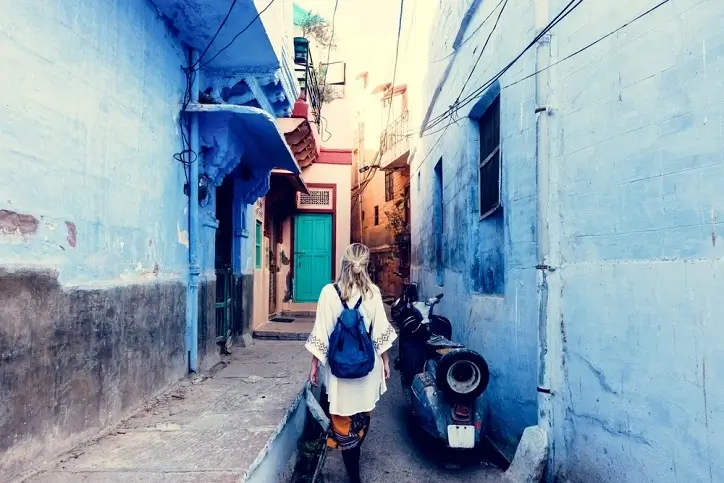
The lane is too narrow for a car, which is exactly why you can smell the marigolds before you reach the flower market, hear the tap of the bangle-maker before you find his doorway, and watch the temple offerings arrive from the stall two turns back. This is India at walking pace, where a city stops being a list of monuments and starts working as a single connected machine.
That is the case for India walking tours, whether you cover two kilometers of a walled city or six through Himalayan forests. This guide has 8 walks worth planning a trip around, plus the seasons and what separates a good morning on foot from a hot, crowded one.
Why Is India Best Explored on Foot?
India’s old cities were built for feet and, at most, for a cart. The walled quarters of Jaipur, the lanes behind the Varanasi ghats, and the bazaar grid of Shahjahanabad all operate at a scale no vehicle can enter and no map can explain. Streets specialize by trade, so one lane sells nothing but silver and the next nothing but wedding cards.
Walking also puts you inside the day’s rhythm rather than alongside it, and the same street at 7 AM and 11 AM is two different places. That is the real argument for walking tours in India: you see it at the speed it was built to be seen.
The Two Kinds of India Walking Tours
It helps to know which kind of walk you are booking, because the two barely resemble each other. City heritage walks run two to four hours over two to four kilometers of flat but broken ground, and the guide’s value lies in what they can tell you about what you see. Countryside and mountain walks can last from half a day to several days and require real fitness. Plenty of travellers assume they want the second option but find they want the first.
8 Walks Worth Planning a Trip Around
Chosen for range rather than ranking, these cover most of what walking tours in India can be: bazaar, riverfront, colonial quarter, tea estate and mountain ridge.
1. Old Delhi
The stretch from Jama Masjid into Kinari Bazaar and Dariba Kalan covers barely two kilometers, yet takes 3 to 4 hours because you stop constantly. Kinari Bazaar sells wedding trim and tinsel garlands, Dariba Kalan has traded silver since the Mughal period, and the spice market at Khari Baoli will set you coughing in the wrong doorway.
Timing matters more here than anywhere else: heritage routes work in the morning when the lanes are passable, but food shops open only in the afternoon, so a street food walk is a separate outing rather than an extension.
2. Jaipur
A heritage walk in Jaipur has one advantage the other old cities lack: Sawai Jai Singh II laid the place out on a grid in 1727, so the lanes make sense. The standard route enters at Chandpole Gate, crosses the flower market at Choti Chaupar, then runs east along Tripolia Bazaar past the lac bangle workshops of Maniharon ka Rasta to Badi Chaupar and Johari Bazaar.
That is two to three kilometers over about two hours on flat ground, best starting around seven, ahead of traffic and heat. UNESCO inscribed the walled city in 2019, which is why so many facades are being restored rather than replaced. Most Classical Rajasthan Tour itineraries pass through without entering these lanes on foot, and a heritage walk in Jaipur is the cheapest way to fix that.
3. Jodhpur
A Jodhpur walking tour usually begins at Toorji ka Jhalra, the stepwell cut from rose-red sandstone in 1740, which lay under silt and parked cars for decades before it was excavated. From there the route climbs into Navchokiya, the oldest quarter, where indigo-washed houses stack against the rock below Mehrangarh.
Two hours covers it, finishing at Pachetia Hill for the view across the blue roofs or at the Clock Tower for Sardar Market. Go early: the lanes are shadeless by mid-morning, and the blue only reads in soft light. This is among the strongest stops on any of the photography tours in India, and a Jodhpur walking tour with a local guide gets you into courtyards a solo wanderer never finds.
4. Varanasi
Eighty-four ghats run about six and a half kilometers along the western bank, from Assi to Raj Ghat. The full line takes four to five hours and a very early start, while the southern circuit to Dashashwamedh runs 2 to 3 hours and covers most of what people come for.
Start before sunrise, when the bathing happens, the stone is cool, and the crowds at Dashashwamedh have not gathered. Walking the ghats costs nothing, but the lanes behind them are a maze, and a guide turns the back streets from disorienting into legible. Photography is not appropriate at the cremation ghats.
5. Kolkata
Kolkata rewards two very different walks, and the colonial route around Dalhousie Square takes in the General Post Office, the Writers’ Building and the Lalit Great Eastern. Established operators run it from seven to ten between April and September, an hour later from October to March.
The second is Kumartuli in the north, the potters’ quarter where clay idols for Durga Puja are built by hand. Workshops run year-round, but the weeks before the autumn festival are when the lanes fill with half-finished goddesses and the quarter smells of wet river clay.
6. Fort Kochi
Few walks pack in this much history per step. Inside three kilometres you pass the Chinese fishing nets, St Francis Church where Vasco da Gama was first buried, the Dutch Palace built by the Portuguese in 1555 and given to the Raja of Cochin, and the Paradesi Synagogue at the end of Jew Town.
2 to 3 hours is enough, and the ground is flat and shaded in stretches. One note catches people out: the synagogue closes Fridays, Saturdays and Jewish holidays, so check before building a route around it. Late afternoon suits this walk best, when the nets are working and the light comes off the water.
7. Munnar
The Kanan Devan Hills above Munnar are laced with estate roads and pickers’ paths, meaning hours on graded track without technical footing. Routes climb out of the tea through Shola Forest into open grassland, and the longer option finishes at Top Station at around 1,700 meters, where chests of tea were once lowered by ropeway to the plains.
Guides are arranged through the estate properties and will shape the route to your time. Mornings often start with mist sitting in the valleys under the ridgelines, burning off by nine or so.
8. McLeodganj to Triund
Triund is where many people take their first Himalayan walk, and it fully earns its reputation. The trail runs about five to six kilometers one way from the Gallu Devi trailhead (or around seven kilometers if walking directly from McLeodganj main square) through oak and deodar forest. You climb for four to five hours until the trees stop and the massive Dhauladhar wall appears across a grass ridge at roughly 2,850 meters.
It is an easy-to-moderate walk that is well within reach of anyone reasonably fit. A mandatory Forest Department fee applies at the Gallu Devi checkpoint, which also enforces strict daily cut-off times for hikers.
Following a strict High Court ruling, overnight camping is limited to a small number of designated tents on the ridge, making advance booking essential. Of all the India walking tours on this list, this is the one to experience during the crisp shoulder seasons rather than the mid-monsoon.

How Much a Guided Walk Costs in 2026?
Prices shift with season, group size and inclusions, so treat these as mid-2026 ranges:
- Jaipur: roughly $5 to $15 per person in a group, $15 to $30 for a private walk
- Jodhpur: around $6 to $15 for a two-hour blue city route
- Old Delhi: from about $10 for a food walk with tastings, more for private heritage routes
- Fort Kochi: about $10 to $25 for two to three hours
- Kolkata: around $25 per person on the established colonial route
- Varanasi: the ghats are free to walk, guided old city routes from about $15
Munnar and Triund differ: estate walks come through your accommodation, and Triund is done independently or with a trekking operator.
Best Time for India Walking Tours by Region
Season affects this more than any other decision: the plains and desert are comfortable in winter and punishing in summer, while the hills invert that.
- Rajasthan and the Northern Plains: November to February, with October and March still fine if you start earlier. Delhi, Jaipur, Jodhpur and Varanasi are pleasant at seven and workable until eleven.
- Kerala and the Western Ghats: October to March, the Ghats cooler than the coast year-round.
- Kolkata: November to February, before the humidity builds.
- Himalayan Foothills: March to June and September to November. Skip July and August, when trails turn to mud and views disappear.
- Valley of Flowers, Uttarakhand: the exception, open only July to September, when it blooms.
Most complaints about India walking tours in the wrong season are really about the wrong hour. One of the most practical tips for travel to India: match your walk to the right season.
What to Carry and How to Walk Well?
Footwear trips up more people than anything else. Stiff hiking boots are wrong for city walking, where the ground is flat but broken and you take your shoes off at temples several times a day. A walking sneaker does best for city pavements; save the boots for Triund and stick to supportive sandals for the Ghats.
- Trousers or a long skirt, and sleeves covering the shoulders, for temple and mosque access
- A scarf, which doubles as head covering, dust filter and sun protection
- Small notes and coins, since vendors and tea stalls rarely carry change
- A refillable bottle plus a filter or purification tablets, since tap water is not drinkable
- Socks you do not mind losing, for barefoot temple courtyards
Two habits matter more than the kit. Ask before photographing someone and accept a refusal without negotiating, which guides say is their most common complaint. Walk slower than it feels natural, because most walking tours in India are short on distance and long on what you would otherwise pass.
Making Room for Walks in a Longer Trip
Walks slot into an itinerary more easily than expected, since they take a morning rather than a day. A Luxury Golden Triangle Tour India route through Delhi, Agra and Jaipur has natural gaps on either side of the Taj Mahal, and a morning heritage walk in Jaipur fits one without displacing anything.
The same holds further west, where a Jodhpur walking tour occupies the two hours before Mehrangarh gets busy. That is the right order anyway, since the fort makes more sense once you have walked the city it guarded. For longer trips, one city walk every second or third day works well, with a hill walk in the middle.
Final Thoughts
Custom Tours India has built private, tailor-made trips since 2017, working out of Jaipur with hand-picked guides nationwide. Because every itinerary is assembled from scratch rather than pulled off a shelf, walks go where they belong: at first light, on the right day, with a guide who knows which courtyards open and which lanes flood.
Tell us how far you want to walk and how much you want explained, and we will build the trip around that. Whether it’s one morning in a walled city or a route stitched together from India walking tours across six states, the itinerary starts from your pace rather than ours.
Get in touch with Custom Tours India to start planning your India walking tours.