You will hear about an Indian wedding before you see it. The dhol drum starts somewhere down the street, a brass band answers, and by the time you reach the venue there is a horse, a dancing crowd, and a groom you have not met yet at the center of it.
This is the moment most international guests realize their mistake: they came expecting a ceremony, and they have walked into something closer to a four-day festival thrown by five hundred of the couple’s closest relatives.
Indian wedding culture treats a marriage as a union of two extended families rather than a private exchange of vows, and as a guest you are not there to watch. You will be handed a plate, pulled onto the dance floor, and seated close to rituals you may not fully follow, and that is exactly the point.
Why Indian Wedding Culture Centers on Family?
The clearest way to reset your expectations is to stop thinking of the couple as the center of the day. In most Indian weddings ceremonies, the two families are the main characters, and the events are structured to introduce them to each other, feed each other, and celebrate together in stages.
This is why relatives fly in from other cities and countries, why cousins choreograph dances weeks in advance, and why a single guest list can span four generations. The Indian wedding experience is as much a reunion as a rite, and the hospitality reflects that: as a visitor you will rarely be left to stand at the edge of the room. Someone’s aunt will find you, ask where you are from, and make sure you have eaten.
What Are the Different Types of Indian Wedding Ceremonies?
India is not one wedding template. Indian wedding traditions shift with the family’s faith, changing the rituals, the language of the vows, and even the venue, so knowing which tradition you are attending will help you follow what is happening. This is one part of Indian wedding culture that guidebooks tend to flatten, so it is worth learning the basics before you go.
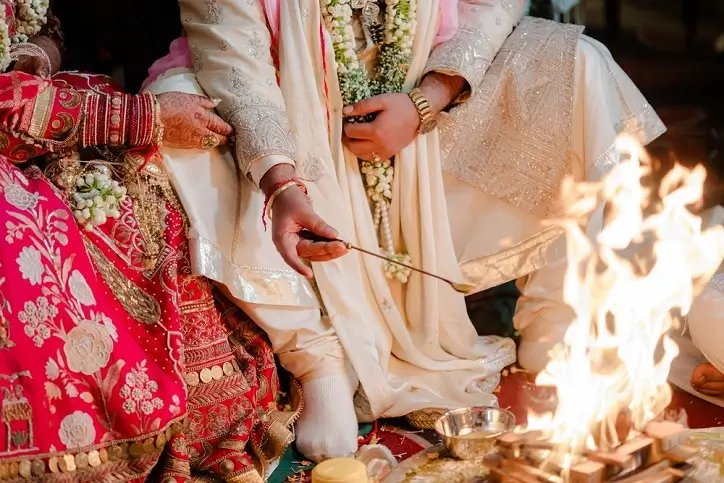
Hindu weddings usually run three to five days and center on Agni, the sacred fire, which serves as the divine witness to the marriage. The ceremony builds through a recognizable sequence:
- Kanyadaan: the bride’s father places her hand in the groom’s and pours water over their joined hands, giving his daughter away.
- Saptapadi: the seven steps or seven vows taken around the fire, which is the legal and spiritual heart of the wedding.
- Mangalsutra and Sindoor: the groom ties a sacred black-beaded necklace around the bride’s neck and applies red vermilion powder along her hair parting, both lasting markers of a married Hindu woman.
Most of the pre-wedding events you have heard of, Mehendi, Sangeet, and Haldi, belong to this tradition.
Muslim weddings are built around the Nikah, the marriage contract, which is both a religious and a legal act. A Qazi, the officiant, leads the ceremony, and the key moments are these:
- Ijab-e-Qubool: the couple gives consent by saying “Qabool hai,” meaning “I accept,” three times.
- Mehr: the groom offers the bride an agreed gift of money or property that is hers to keep.
- Nikahnama: the marriage contract is signed before witnesses.
- Walima: a reception feast hosted by the groom’s family that publicly announces the marriage.
The bride’s farewell to her family afterward is known as the Rukhsati.
Sikh weddings, called Anand Karaj, meaning “blissful union,” take place in a Gurdwara in the morning. The couple circle the Guru Granth Sahib, the Sikh holy scripture, four times during the Laavan, the four marriage hymns, each round representing a stage of married and spiritual life. Heads are covered throughout, and everyone sits on the floor as equals.
Christian weddings in India follow a church format that will feel familiar to many Western guests, with an exchange of vows and rings before a priest, though they often carry local touches like sari-clad bridesmaids and a lively evening reception with Indian food and music.
Understanding these differences is the difference between watching a ritual and understanding it, and it shapes how you dress, when you cover your head, and what you say to the hosts.
The Pre-Wedding Events: Mehendi, Sangeet, and Haldi
The celebrations begin days before the marriage itself, and this is where Indian wedding culture reveals its warmth, since for many guests these smaller gatherings are the most welcoming part of the whole Indian wedding experience. They are less formal than the main day, which makes them the easiest place to join in.
- Roka or Engagement: the formal announcement of the match, where the families exchange gifts and blessings.
- Mehendi: intricate henna is applied to the bride’s hands and feet, often with the groom’s name hidden in the design. Female guests are usually welcome to get a smaller design done, and the darker the stain sets over the next day, the better.
- Sangeet: an evening of music and choreographed dance, with both sides performing, sometimes competitively. If someone pulls you up to dance, say yes; nobody is judging your technique.
- Haldi: a turmeric paste is applied to the couple’s skin to bless and brighten them before the wedding. It is messy and joyful, and guests are sometimes invited to dab a little on as well.
These are among the oldest Indian wedding traditions still practiced daily across the country, and they are where you will feel most like a participant rather than an observer.
The Wedding Day: Baraat, Mandap, and Vidaai
The wedding day itself, the ceremony at the center of a traditional Indian wedding, is longer and more solemn, though in India, even solemnity involves music, movement, and a crowd. It usually opens with the Baraat, the groom’s procession, where he arrives on a decorated horse or in a car, led by a dancing party of family and friends and a live band.
Guests are welcome to join the procession, and it is one of the high-energy moments of Indian wedding culture that photographs rarely capture in full.
Once everyone settles, the wedding moves under the Mandap, a decorated canopy that represents the couple’s new home. The rituals here vary by region and faith, but in Hindu weddings you will often see the Jaimala, an exchange of flower garlands, followed by the couple circling a sacred fire.
As one of the most sacred Indian wedding traditions, the Saptapadi sees the couple walk around the sacred fire to make their seven promises. Each step represents a commitment to nourishment, strength, prosperity, family, and lifelong partnership.
Vidaai comes at the end, when the bride leaves her family home. It is openly emotional, and you will see tears; it marks a daughter’s departure as much as a couple’s beginning.
The reception follows, usually the most glamorous evening of all, with the finest outfits, a long dinner, and dancing that runs late.
Across these Indian weddings ceremonies, the through-line is participation. You are meant to eat, move, and celebrate, not sit quietly and clap.
Indian Wedding Etiquette: What to Wear, Bring, and Expect
A little preparation goes a long way, and showing that you have made an effort to understand Indian wedding culture signals real respect for the hosts.
The single most useful thing to know about a traditional Indian wedding is that guests are expected to look festive, not muted, so this is not the occasion to play it safe in grey.
- Colors: wear bright, warm colors. Avoid black and white, which are associated with mourning, and avoid pure red, which is often reserved for the bride.
- Women’s attire: a saree, a lehenga, or an Anarkali suit all work well. Renting or buying one locally is easy and appreciated.
- Men’s attire: a kurta-pajama for daytime events, or a sherwani for the ceremony and reception. A Nehru jacket over a kurta is a simple, safe choice.
- Gifts: Cash in a decorated envelope is the standard and is always welcome. A thoughtful gift from your home country also lands well.
- Footwear: wear shoes you can slip off easily, since you will remove them before entering ceremonial spaces and temples.
- Food and drink: expect a large vegetarian spread, and note that some weddings, particularly religious ones, serve no alcohol at all.
- Photography: photograph freely at the lively events, but hold back during the most sacred moments unless you see the family’s photographer working closely.
Pace yourself with the food and the late nights, because a multi-day Indian wedding experience rewards stamina more than enthusiasm alone.
When to Go and Where These Weddings Happen?
Most Indian weddings fall between October and March, when the weather is mild and the monsoon has passed. If you have any flexibility, this is the window to aim for, both for comfort and because it is peak season and you will find celebrations happening almost everywhere.
Region shapes the flavor of the event, and Indian weddings ceremonies look noticeably different from one state to the next. A Rajasthani wedding leans royal and grand, a South Indian ceremony is often earlier in the day and temple-centered, and a Goan celebration blends Western and Indian elements against the coast.
- Rajasthan: the palace cities of Udaipur and Jaipur host some of the most opulent celebrations in the country, which is why a destination wedding in India so often means Rajasthan.
- Goa: beaches and a relaxed, cross-cultural mood, popular for couples wanting something less traditional.
- Kerala: the backwaters make a quiet, scenic backdrop for smaller gatherings.
Among the best wedding destinations in India, these three cover most of what an international guest is likely to encounter. If the wedding is your first trip to the country, it pairs naturally with a Golden Triangle Tour India route through Delhi, Agra, and Jaipur, letting you see the Taj Mahal and the forts of Rajasthan on either side of the celebration.
Attending One Well with Custom Tours India
A traditional Indian wedding is one of the few occasions where a stranger is folded into the family within an hour of arriving and where your only real job is to show up, eat, and join in.
Understanding the rhythm of the events, dressing the part, and knowing when to step back during a ritual will carry you through with grace, and it will deepen how much of the celebration you take in.
The logistics are the hard part: moving between venues in an unfamiliar city, timing your arrival to the season, and understanding the significance of each ritual as it unfolds.
That is where Custom Tours India can help, arranging travel, guidance, and timing around the celebration so you can give your full attention to the wedding itself. Indian wedding culture is best experienced as a guest who understands what they are seeing, and a little planning is what makes that possible.
Book your journey with Custom Tours India today and arrive at the wedding ready!